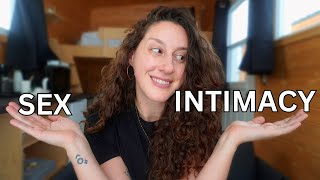
Here's a question that tends to make people uncomfortable: does sex need to end in orgasm to be good? If you asked most people, they'd say yes without even thinking about it. Orgasm is the finish line, the measuring stick, the thing that tells you the sex "worked." But what if that way of thinking is actually limiting your pleasure instead of enhancing it?
I've been thinking about this a lot lately, especially because so many of the messages I receive from viewers involve some version of "I can't orgasm during sex" or "my partner can't finish" or "something must be wrong with me." And in almost every case, the underlying problem isn't physical. It's the pressure. The obsession with reaching a specific destination is stealing the joy from the journey.
The Orgasm Obsession
Our culture has built an entire mythology around orgasm. It's portrayed as the ultimate measure of sexual satisfaction, the proof that both people did a good job, the natural and inevitable conclusion of any sexual encounter. But this narrative doesn't reflect reality for a lot of people, and when your experience doesn't match the script, it can create anxiety, shame, and a sense of failure.
The truth is that orgasms are wonderful, but they're not the only form of sexual pleasure, and they're not always accessible. Factors like stress, medication, hormonal changes, fatigue, and mental health can all affect orgasm. And for many women especially, orgasm during partnered sex — particularly from penetration alone — simply isn't a given. That doesn't mean the sex is bad. It means the metric is wrong.
What Happens When You Remove the Pressure
Something remarkable happens when you take orgasm off the table as a requirement: you actually start enjoying sex more. Without the countdown clock in the back of your mind, without the constant self-monitoring of "am I close yet?", you're free to be genuinely present. You notice sensations you were too distracted to feel before. You connect with your partner in a deeper, more relaxed way.
I've experienced this personally, and I've heard from countless viewers who describe the same thing. When you stop chasing orgasm, the entire sexual experience opens up. You might discover that certain kinds of touch feel incredible even though they'd never lead to orgasm. You might find that the intimacy and emotional connection of sex are deeply satisfying on their own. And ironically, many people find that orgasms come more easily when they stop trying so hard to have them.
Redefining "Good Sex"
If orgasm isn't the measure of good sex, then what is? I think it comes down to a few things:
- Presence — were both people fully engaged and connected during the experience?
- Pleasure — did it feel good, in whatever form that took?
- Communication — did both people feel comfortable expressing their needs and desires?
- Connection — did you feel closer to your partner afterwards?
- Satisfaction — not in terms of a specific outcome, but in terms of the overall experience
When you start evaluating your sexual experiences by these criteria instead of by whether or not someone climaxed, you'll likely find that many encounters you'd previously written off as "failures" were actually quite good. And that shift in perspective can be genuinely liberating.
This Isn't About Settling for Less
I want to be clear: I'm not saying orgasms don't matter or that you should stop pursuing them. Orgasms are fantastic, and if you're struggling with orgasm and want to work on it, that's a completely valid goal. What I am saying is that tying your entire sexual satisfaction to one specific outcome creates a fragile system. If the orgasm happens, great. If it doesn't, the entire experience is labeled as a failure, and that's not fair to you or your partner.
The healthiest approach is to hold orgasm as a welcome possibility rather than a requirement. Enjoy the build-up for its own sake. Appreciate the sensations along the way. Delight in the closeness with your partner. And if orgasm shows up as part of that experience, wonderful. If it doesn't, you've still had a meaningful, pleasurable encounter.
A Different Way to Think About It
I often use this analogy: imagine going on a beautiful hike in the mountains. The summit is incredible, sure. But if you spent the entire hike fixated on reaching the top, you'd miss the views, the wildflowers, the feeling of the breeze, and the conversation with the person walking beside you. The journey matters. The summit is just one part of it.
Sex works the same way. The orgasm is the summit, but the touching, the kissing, the eye contact, the whispered words, the laughter, the vulnerability — all of that is the hike. And the hike is where most of the magic happens. I talk about this at much greater length in the video, including some practical ways to shift your mindset. I hope it helps you see your sexual experiences in a new light.